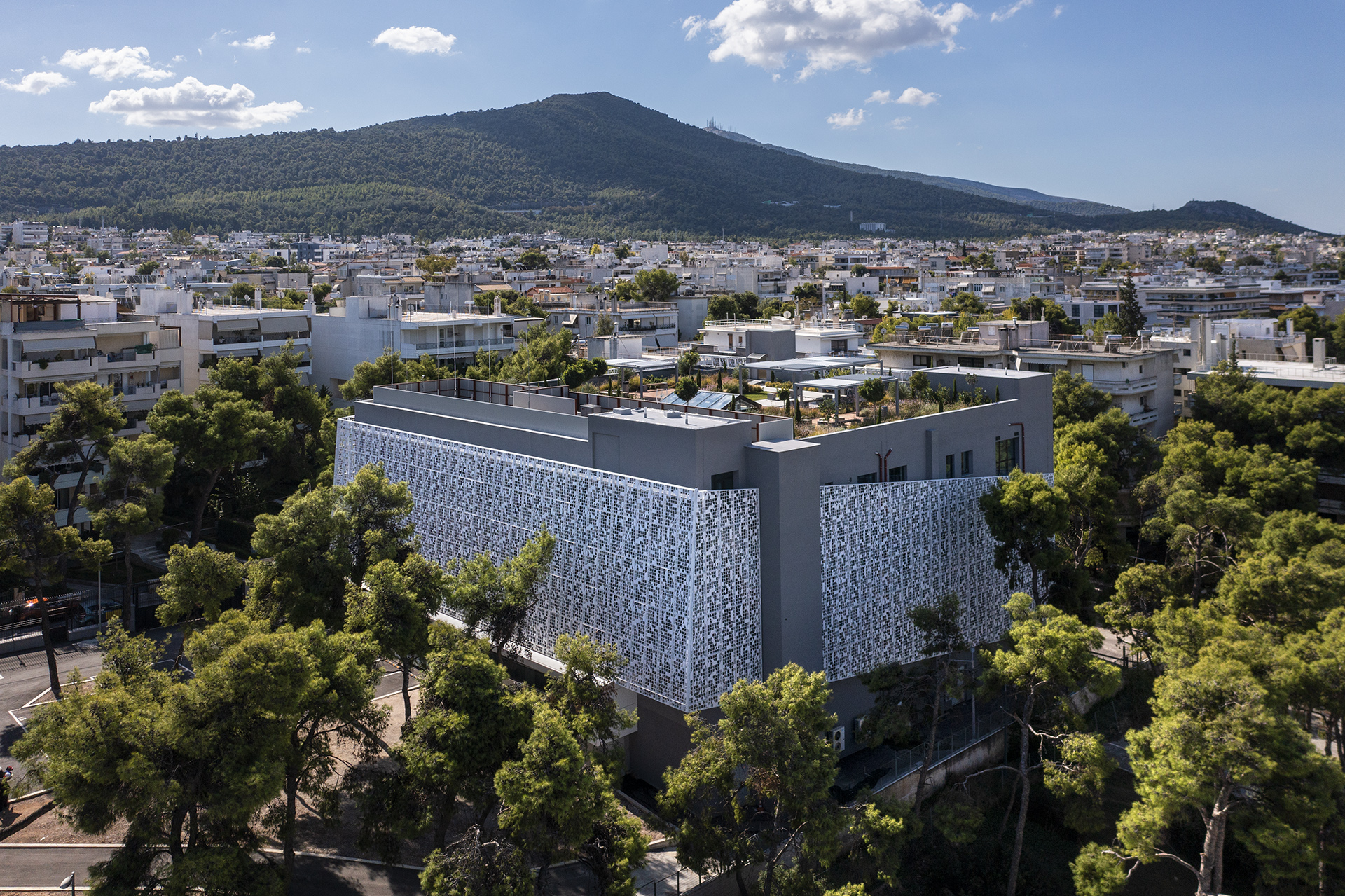
Building Complex OTE ESTATE in Agia Paraskevi, Athens
By: Alexandros C. Samaras & Associates
The sloped plot, with an area of 3,852m², is adjacent to the ERT facilities in Agia Paraskevi, Attica. The existing building, a three-story structure with a basement and a roof, covering 1,152m² and with a total floor area of 3,982m², was constructed in two phases, in 1968 and 1987, with two entrances and two staircases, but without an elevator. It operated as a telecommunications center, resulting in a significant portion of the facades and the roof being gradually occupied by electromechanical equipment.
The renovation of the building aims to create a cohesive unit of office spaces and areas for the Olympia Radio station, with criteria of functionality, accessibility, sustainability, and aesthetics. It was constrained by the need to maintain certain mechanical spaces, such as the distributor room, in specific locations.
The architectural design includes the rearrangement of spaces, enhancement of entrances, replacement of one staircase, addition of elevators, and access to the roof. Additionally, it envisions the creation of an atrium for natural lighting and ventilation of the highly compact building’s center, with a variable cross-section due to the aforementioned constraint. The roofs formed within the atrium will be planted. The peripheral surfaces, which will be solid after the window openings are made, will also be planted with vertical gardens. Similarly, the building’s roof will be planted and designed as a break area with a view.
The office spaces will be developed with an open floor plan and will feature raised floors, sound-absorbing elements, and visible electromechanical equipment, except for the executive offices and meeting rooms.
The design includes a number of special discussion rooms for brainstorming among the members of the company’s think tank, as well as a cafeteria, a medical office, archive rooms, a data center, and data recovery facilities in case of emergencies.
A significant aspect of the architectural study was the energy upgrade of the building for comfort and economy reasons. Thermal insulation will be added to the existing exterior walls, and the entire building will be clad in an energy-efficient envelope made of perforated aluminum sheets painted white. This contributes to shading the openings and creates ventilated facade conditions, acting as a second skin for the building.
The perforation pattern of the sheets will develop with densities and sparsities on a pixel grid, representing the cutting-edge digital technology used by the owner company’s group on the building’s facade. The perforated sheets will be mounted on a frame attached to the building’s structural system, at a distance from the facade. In this gap, overlapping perforated walkways will be installed for the maintenance and cleaning of the facades.
The surrounding area will be cleared of various concrete constructions for machinery bases and a portable telecommunications center and will be newly landscaped.